
It’s usually a beeping box on a post in the yard, often with a red light, and it tends to go off at the worst possible time. If your septic alarm is going off, don’t panic. In most cases you have some time to act, and a few simple steps right now can keep a small problem from turning into a backup.
Here’s what the alarm means, what to do first, and when it’s time to call for a repair.
Why your septic system has an alarm
Not every septic system has an alarm. You’ll find one on systems that use a pump, such as a pump tank sending wastewater uphill to the drain field, or an engineered system like a low-pressure pipe (LPP) or drip system. Those are common across Union, Stanly and Mecklenburg counties on lots where the soil or the slope won’t work with a plain gravity system.
In a pump system, wastewater flows from the septic tank into a second tank, the pump tank. Floats inside that tank turn the pump on and off as the level rises and falls. A separate float sits higher up and sets off the alarm if the water gets too high.
North Carolina’s septic rules require that setup. Under 15A NCAC 18E .1103, a pump tank must have a high-water alarm that is both audible and visible, has a silence button on the outside of the panel, can be tested by hand, and keeps working even when the pump doesn’t.
So the alarm isn’t telling you the system has failed. It’s telling you the water in the pump tank has climbed higher than it should.
What to do when the alarm goes off
1. Press the silence button. The button is on the outside of the alarm box. It quiets the horn, but the light usually stays on until the problem clears.
2. Cut back on water right away. No laundry, no dishwasher, short showers, and flush only when you need to. Every gallon you send down the drain goes into a tank that’s already high.
3. Check the breaker. A tripped breaker is one of the more common causes. Look in your home’s electrical panel for a breaker labeled for the septic pump or alarm, and see if it has tripped. If you reset it and it trips again, leave it off and call us. That points to an electrical or pump problem.
4. Think about what just happened. Did you run several loads of laundry, have extra guests, or get a hard rain? A burst of water can push the level up faster than the pump can move it, and the alarm may clear on its own within a few hours once things settle down. If it comes back, have it looked at.
5. Don’t open the tank or the control panel. The control panel has live electrical parts, and septic tanks hold dangerous gases. Opening lids and reaching into a pump tank is a job for a trained crew with the right equipment.
How much time do you have?
Pump tanks are built with extra room above the alarm level, called emergency storage, so a household has time to get help. North Carolina sets the minimum in 15A NCAC 18E .0802. For a typical home without standby power, that’s 12 or 24 hours of storage, depending on the nearby surface waters the system was designed around.
That’s a minimum based on normal water use. Keep running water like nothing happened and you’ll use it up much faster. Once it’s gone, wastewater can back up into the house or come up in the yard. Cut back on water and call.
Common reasons the alarm goes off
When we come out for an alarm call, the cause is usually one of these:
- A failed pump. Pumps wear out, especially older ones or ones that have been pumping debris.
- A stuck or failed float. Floats can get tangled, coated or simply stop working, so the pump never gets the signal to turn on.
- Power or panel problems. A tripped breaker, a bad connection, or a failed part in the control panel.
- Too much water coming in. Heavy water use, a running toilet, or groundwater leaking into a tank or riser during a long rain. Our red clay soils hold water, so heavy rain can show up in a tank that isn’t sealed well.
- A clog. Solids carried over from a septic tank that’s overdue for pumping, or a clogged effluent filter or line.
- A problem farther down the line. If the pump runs but can’t push water out, the issue may be a stuck valve or a problem in the supply line or drain field.
What happens on a repair visit
We start by finding out why the level is high. That usually means checking the panel and power, opening the pump tank, testing the pump and floats, and looking at the septic tank and filter. If the tank needs pumping to get to the problem, we’ll tell you.
Then we explain what we found and what it will take to fix it before we do the work. In Weddington this August, for example, we installed a new control panel with new floats and a float tree on a pump tank, replaced the internal gate valves, added a precast riser, and blew out and reset the pressure on all the laterals.
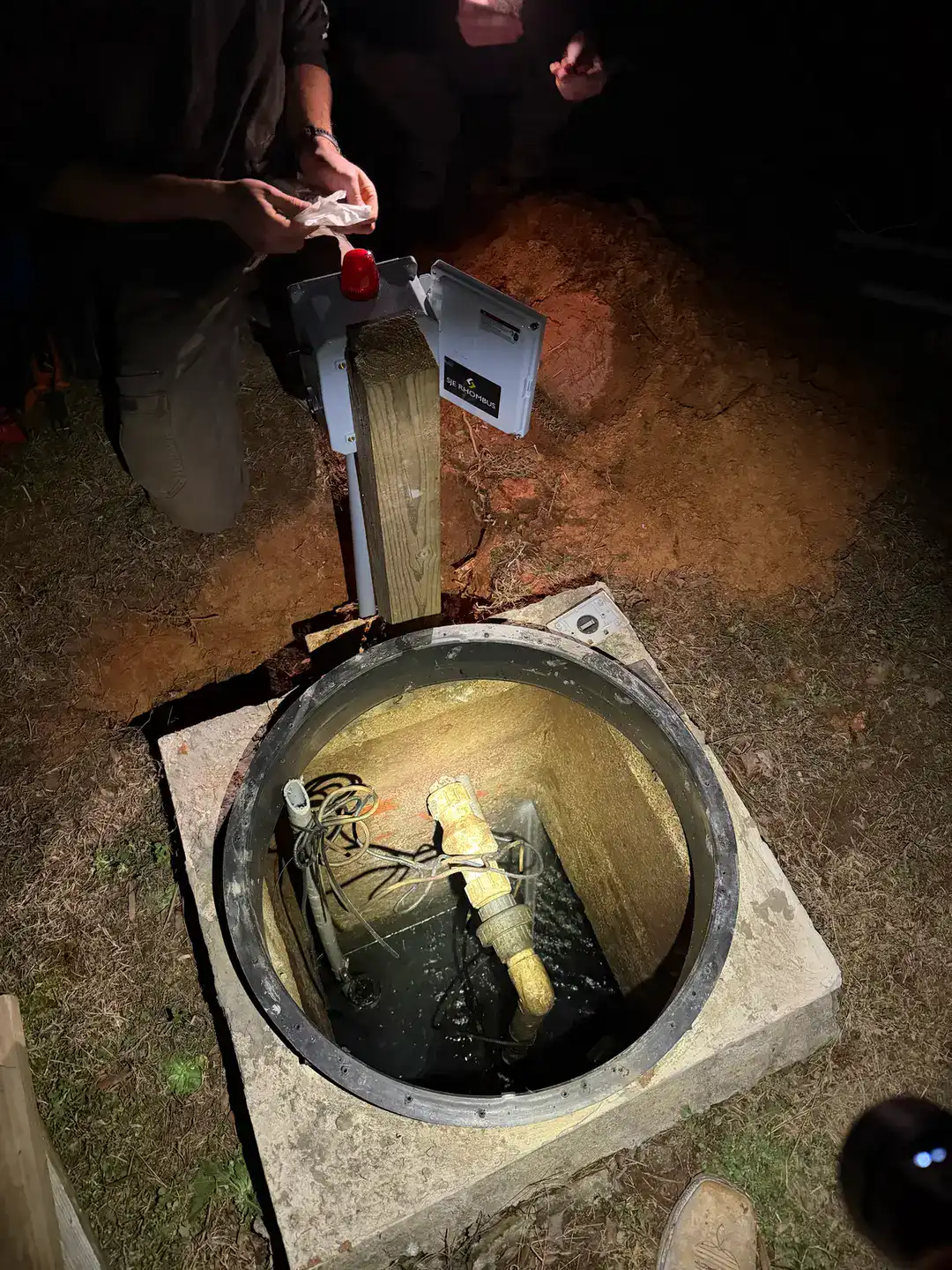
If your system has a pump, it’s worth a regular check even when the alarm is quiet. Some systems are required to have a certified operator. See our septic operator contracts page for how that works.
Learn more about our septic repair service, or see the areas we cover in Union County and Weddington.
Frequently asked questions
Can I just turn the septic alarm off?
You can silence the horn with the button on the alarm box, but don’t unplug or switch off the alarm itself. It’s your only warning before wastewater has nowhere to go. If it keeps going off, something needs to be fixed.
Why does my septic alarm go off when it rains?
Usually because rainwater or groundwater is getting into the tank, through a riser, lid or pipe that isn’t sealed. It can also mean the system is struggling to keep up. If it happens after every big rain, have it checked.
Is a septic alarm an emergency?
It’s urgent, but it usually isn’t a disaster if you act quickly. Silence it, cut back on water, check the breaker, and call. If sewage is backing up into the house or coming up in the yard, tell us right away.
Septic alarm going off? Call or text us
Dahl Septic Services is a licensed septic contractor (NC #9407I). Founded in 2023, backed by over a decade of hands-on septic experience with pumps, floats, panels and engineered systems. Our office hours are Monday through Friday, 8 to 5.
Call or text (704) 218-9070, book online, or request a quote.