
Dahl Septic Services · LPP Septic Systems
LPP Septic Systems: Installs, Repairs and Operator Visits in NC
An LPP septic system (low-pressure pipe) is what the county often permits when a lot’s soil is too shallow, too rocky or too slow-draining for a plain gravity drain field. Dahl Septic Services installs, repairs and services LPP systems across Union, Stanly, Mecklenburg, Cabarrus, Anson and Montgomery counties. Licensed and insured, NC #9407I. Founded in 2023, backed by over a decade of hands-on septic experience.
- Licensed & insured, NC #9407I
- Founded in 2023, backed by over a decade of hands-on septic experience
- Grade Level IV contractor certification
- Certified subsurface operator on our team
Quick facts
Quick facts: LPP septic systems
| Topic | Details |
|---|---|
| What it is | A septic tank, a pump tank and low-pressure pipe laterals that spread each dose across the field |
| NC system type | Type IVa (15A NCAC 18E .1301, Table XXXII) |
| Operator visits (state minimum) | 2 per year, by a certified operator |
| County compliance inspection | Every 3 years |
| Contractor certification | Grade Level IV |
| Where | Union, Stanly, Mecklenburg, Cabarrus, Anson and Montgomery counties, NC |
| License | NC #9407I · licensed and insured |
| Hours | Mon–Fri 8–5 · call or text (704) 218-9070 |
How it works
How an LPP septic system works
- Septic tank. Solids settle and scum floats, just like a conventional system.
- Pump tank. Clear effluent flows into a second tank with a pump, floats and a high-water alarm.
- Dosing. When the floats reach the “on” level, the pump sends a measured dose out under low pressure.
- Low-pressure pipe laterals. Small-diameter pipes with drilled holes spread that dose evenly across the whole field. A gravity field soaks most of the water in at the front end of the trenches.
- Turn-ups. Capped ends at each lateral let an operator check the pressure (the squirt height) and flush the lines.
Because the field is dosed and evenly spread, an LPP system can work on shallower soil than a gravity field needs. The trade-off is moving parts: a pump, floats, an alarm, a control panel and small holes that can clog. On even tighter sites, the county may call for a drip septic system instead.
Soils
Why your lot may need one
In our area it’s usually the ground. Much of Union and Stanly counties is Carolina Slate Belt, where USDA’s soil maps show soils like Badin, Tarrus and Goldston: shallow to moderately deep over rock, with slow water movement in the clay subsoil. The county’s Environmental Health staff or a Licensed Soil Scientist evaluates your lot and decides the system type. We install what the permit calls for. See the soil notes on our Monroe, Weddington and Albemarle pages.
Installs
Installing an LPP septic system
- Permit first. A new or replacement LPP system needs the county’s soil/site evaluation, an Improvement Permit and a Construction Authorization. How permits work
- Site work. We clear the site for the county’s evaluation and for the install. Land clearing
- Install to the permit. We set the septic tank and pump tank (plastic or concrete, as permitted), wire in the floats, alarm and control panel, and lay the pressure manifold and laterals to the design.
- Inspection and Operation Permit. The county inspects the system, and because an LPP system needs a certified operator, North Carolina requires a signed operation and maintenance contract before the county issues the Operation Permit (15A NCAC 18E .1303).
Our NC contractor certification is Grade Level IV, the level required for LPP and drip systems. Every LPP install is quoted per site after we see the permit and the lot. Financing is available. Septic system installation
Repairs
LPP repairs
Common LPP problems we fix:
- An alarm that keeps sounding: a failed pump, a stuck or tangled float, a tripped breaker or a bad control panel
- A pump that runs all the time, or not at all
- Wet spots or effluent surfacing over the laterals when the pump runs
- Clogged lateral holes, usually from solids carried over from a tank that went too long without pumping
- Broken or crushed lines from vehicles, roots or construction
Swapping a pump, float or panel for an identical part counts as maintenance under the state rules, and when it’s done by your operator it’s reported to you and the county within 30 days (18E .1301(h)). Bigger repairs may need a county repair permit. Septic repairs
NC rules
What North Carolina requires after it’s installed
North Carolina classifies an LPP system as Type IVa. The state’s table says it must be managed by a certified operator (or a public management entity with one), with at least 2 operator inspections a year and a county compliance inspection every 3 years (Table XXXII, 15A NCAC 18E .1301). That applies to systems installed or repaired after July 1, 1992. Your Operation Permit can set more than the state minimum.
Our team includes a certified subsurface operator, so we can be your operator under contract. What a contract includes: septic operator contracts in NC.
LPP septic maintenance
An LPP septic maintenance visit is the scheduled operator check North Carolina requires at least twice a year for these systems (your Operation Permit can require more). On a typical visit we:
- Watch a full dose cycle and check the pump, floats, high-water alarm and control panel
- Measure the squirt height at the turn-ups and flush the laterals when solids have built up
- Check the septic tank, effluent filter and pump tank
- Walk the drain field for wet spots or effluent that surfaces when the pump runs
You get a written report after the visit, and a copy is filed with the county as the rules require. The full visit checklist, and how to start a septic maintenance contract, are on the septic maintenance page.
Recent job
Job example
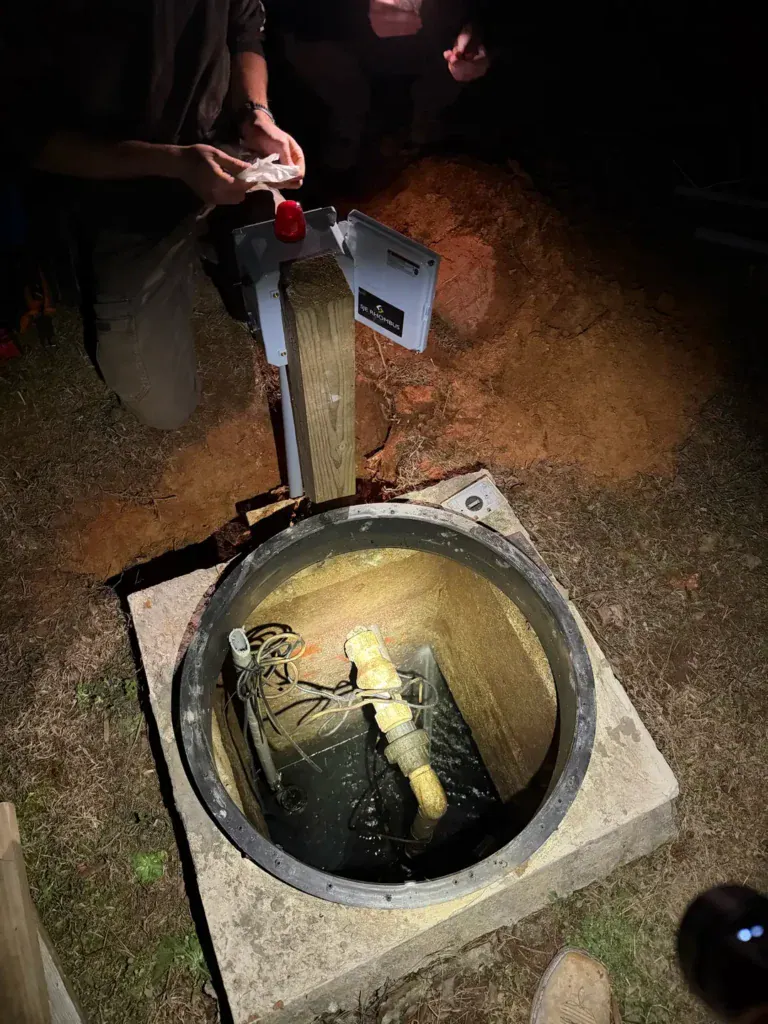
LPP line service, Monroe (March 2026)
We purged LPP lines on a system in Monroe.
FAQ
LPP septic system questions
What does LPP stand for?
Low-pressure pipe. A pump doses effluent under low pressure through small drilled pipes, so it spreads evenly across the drain field.
Is an LPP system the same as a pump-tank system?
Every LPP system has a pump tank, but not every pump tank feeds an LPP field. Some pump tanks just lift effluent up to a gravity field. The state treats them differently: an LPP system needs a certified operator, and a single-pump system feeding a gravity field can be maintained by the owner. Your Operation Permit says which you have.
Does an LPP system need a maintenance contract in NC?
Yes, for systems installed or repaired after July 1, 1992. The state requires a certified operator under a written contract, with at least two operator inspections a year.
Why is my LPP alarm going off?
The water in the pump tank is higher than it should be, usually because of a pump, float, breaker or panel problem, or heavy water use. Cut back on water and call or text (704) 218-9070.
Can I install an LPP system myself?
No. In North Carolina, low-pressure dispersal systems have to be installed by an on-site wastewater contractor certified at Grade Level IV by the NCOWCICB.
How long does an LPP system last?
It depends on the soil, how well the tank is kept pumped, and whether the pump and laterals are serviced on schedule. We won’t promise a number. A check tells you how the system is working that day.
Service area
Where we work on LPP systems
Union County: Monroe, Indian Trail, Waxhaw, Weddington and the rest of Union County. Stanly County: Albemarle and the rest of Stanly County. We also work in Mecklenburg, Cabarrus, Anson and Montgomery counties.
Get started
Get an LPP septic system installed, repaired or serviced
Call or text (704) 218-9070, book online, or request a quote. We’re open Monday to Friday, 8 to 5.
Dahl Septic Services
Call, text or book online
214-B E North St, Albemarle, NC 28001 · Mon–Fri 8–5 · NC #9407I
Visit
Dahl Septic Services
214-B E North St
Albemarle, NC 28001
Call or text
Hours
Mon–Fri 8–5
Closed Thanksgiving (Thu, Nov 26) and Christmas (Fri, Dec 25).